
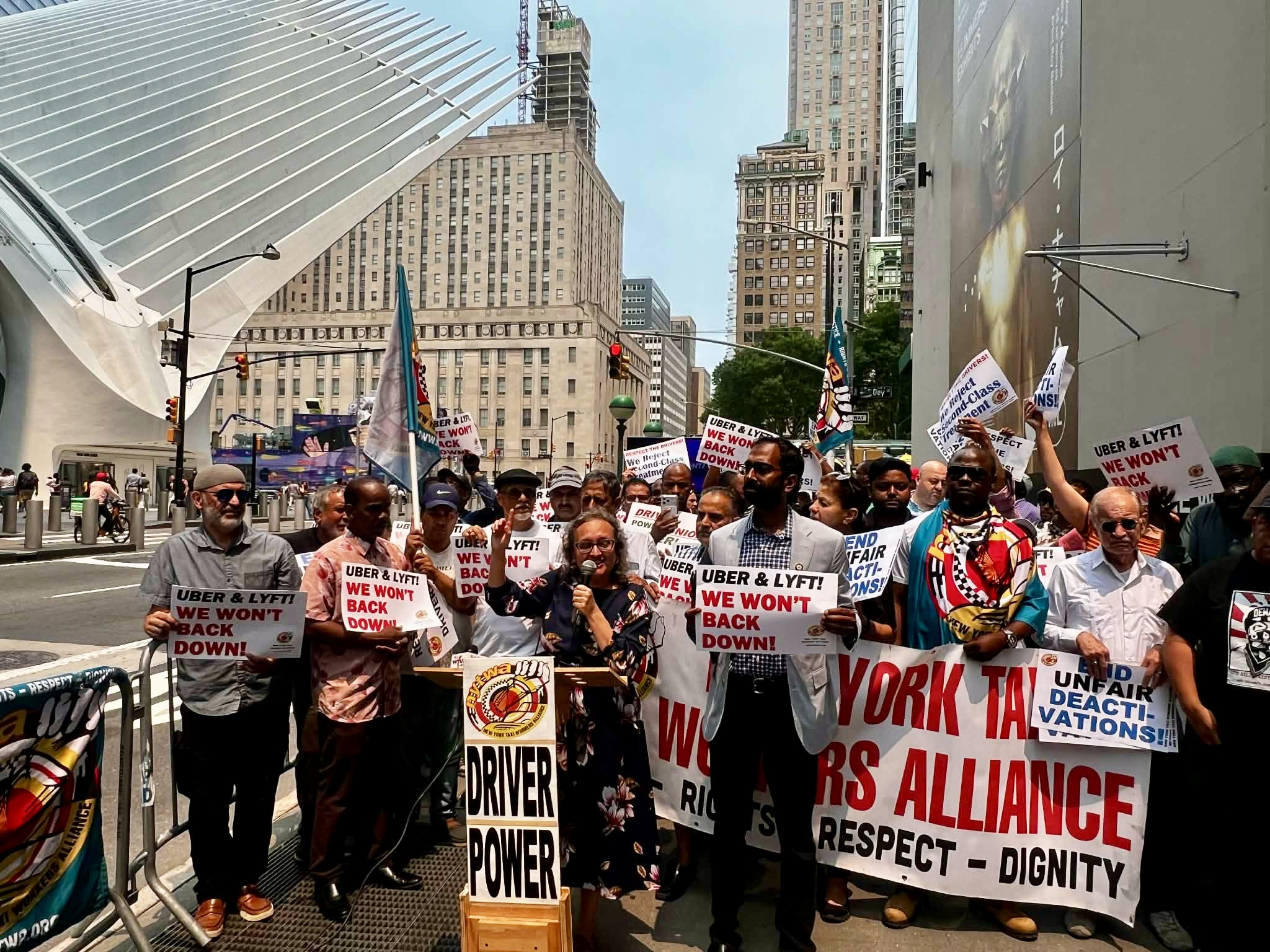
NEW YORK, July 14 (NYCDV) – Hundreds of taxis and for-hire vehicle (FHV) drivers gathered outside Uber’s Manhattan headquarters here today to protest the company’s legal challenge to New York City’s driver deactivation law, arguing that the legislation guarantees essential due process before drivers can lose access to their livelihood.
The rally, organized by the New York Taxi Workers Alliance (NYTWA), underscored growing concerns that the outcome of the lawsuit could reshape employment protections for thousands of app-based drivers across New York City.
Union leaders and drivers warned that weakening the law would make it easier for ride-hailing companies to permanently deactivate drivers without a fair opportunity to contest the decision, describing the legal battle as one of the most consequential labor disputes facing the city’s gig economy.
Among those addressing the rally were NYTWA Executive Director Bhairavi Desai, New York City Council Member Shekar Krishnan, Richard Blum, Staff Attorney with the Employment Law Unit of the Legal Aid Society’s Civil Practice, and Niji Jain, Legal Director of the Asian American Legal Defense and Education Fund (AALDEF), who called for stronger legal protections and greater transparency in the driver deactivation process.
Speaking to NYC Drivers’ Voice, app-based driver Mir Khayer, said Uber first deactivated his account in 2019 before later restoring it after he completed company-required training.
“Uber called me after the deactivation and asked me to attend training. I completed the training successfully, and my account was reactivated. However, two hours later, my account was deactivated again citing ratings issue,” Khayer said.
Another driver, Shahin Mia, who has worked as an Uber driver for more than a decade, said he lost access to his account in 2022 despite maintaining what he described as an excellent driving record.
Recalling the incident, Mia said he had been driving for nearly 12 hours when a passenger repeatedly gave conflicting directions before becoming aggressive.
“The passenger argued with me, became verbally abusive, and approached me aggressively. Soon afterward, my account was deactivated,” he said.
Saif Aizah, another driver who attended the rally, said losing access to the Uber platform had devastating financial consequences.
“After my account was deactivated, I fell behind on my mortgage and vehicle loan payments and eventually had to file for bankruptcy,” he said.
The legal dispute began on June 10, when Uber filed a lawsuit seeking to block Local Law 52, arguing that the legislation would interfere with its ability to remove drivers from its platform when necessary. Less than 24 hours later, Lyft filed a similar lawsuit in federal court in Manhattan.
The two transportation network companies (TNCs), which collectively serve the majority of New York City’s approximately 180,000 app-based drivers, argue that the law could make it more difficult to remove drivers who may pose risks to passenger and public safety.
Local Law 52 was enacted after the New York City Council voted on February 1 to override former Mayor Eric Adams’ veto, which had been issued on December 31, 2025.
The law is scheduled to take effect on July 28, 2026. It would prohibit ride-hailing companies from deactivating drivers without just cause and require companies to provide drivers with at least 14 days’ notice before deactivation, except in cases involving alleged egregious misconduct.


One Response
Thank you, journalist, for an insightful report highlighting the suffering, dedication, and resilience of NYC taxi drivers who work long hours under challenging conditions.