

New York City taxi and for-hire vehicle drivers may soon gain access to thousands of additional legal parking spaces under a proposed Department of Transportation rule intended to ease one of the industry’s most persistent daily challenges.
During a public hearing on the proposed rule allowing taxi and FHV drivers to use commercial metered parking spaces here today, drivers and advocates highlighted how the shortage of legal stopping places often prevents drivers from taking essential breaks to use restrooms, eat, stretch, or briefly recover from long hours behind the wheel.
The proposed rule, required under Local Law 24 of 2026, would allow taxis and for-hire vehicles to park in commercial metered spaces.
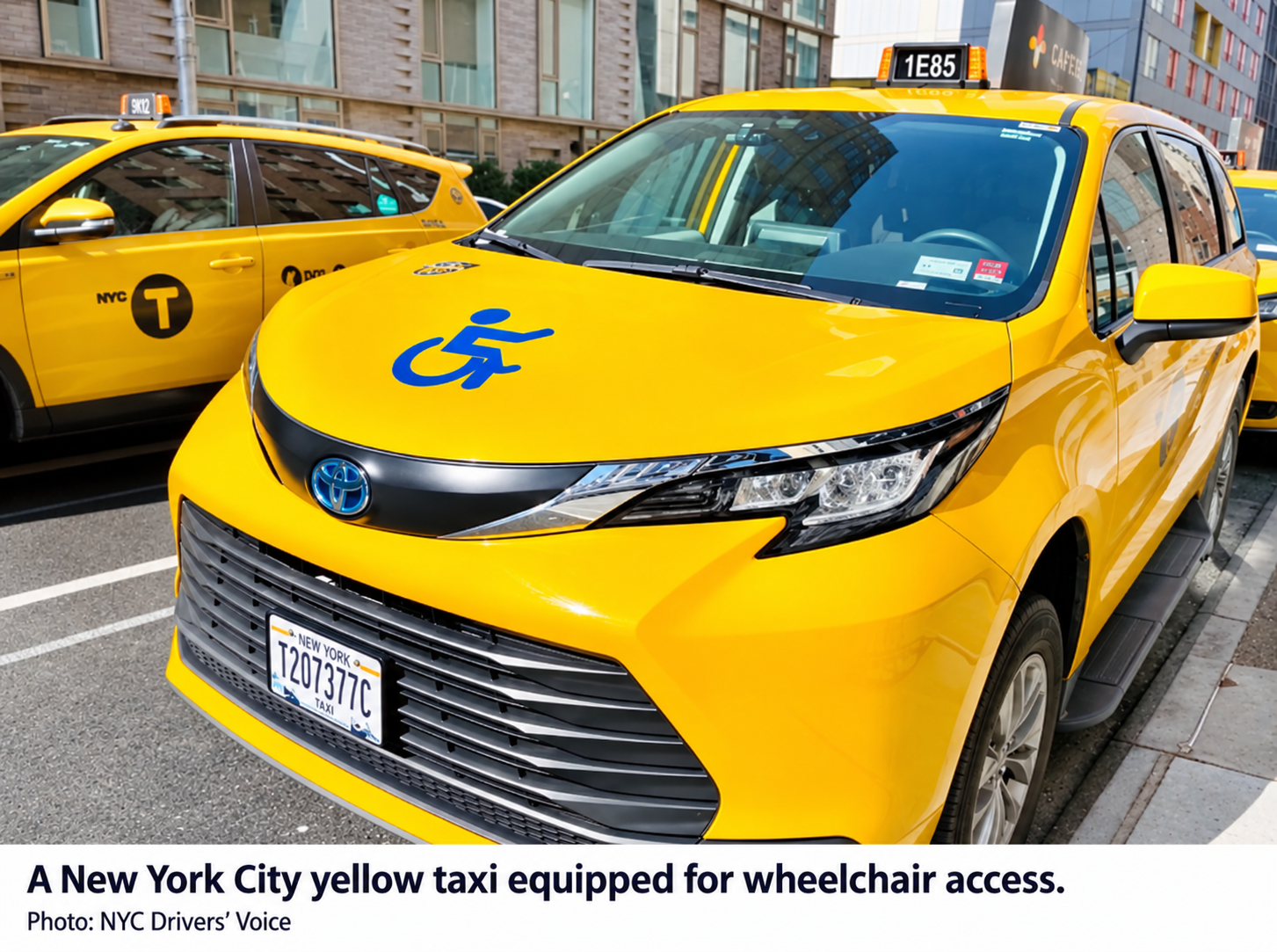
Yellow cab drivers currently have access to only 151 taxi-exclusive parking spaces south of 60th Street and 137 spaces shared with app-based drivers. The pilot would add approximately 13,000 commercial metered spaces, where drivers could park for breaks for up to three hours.
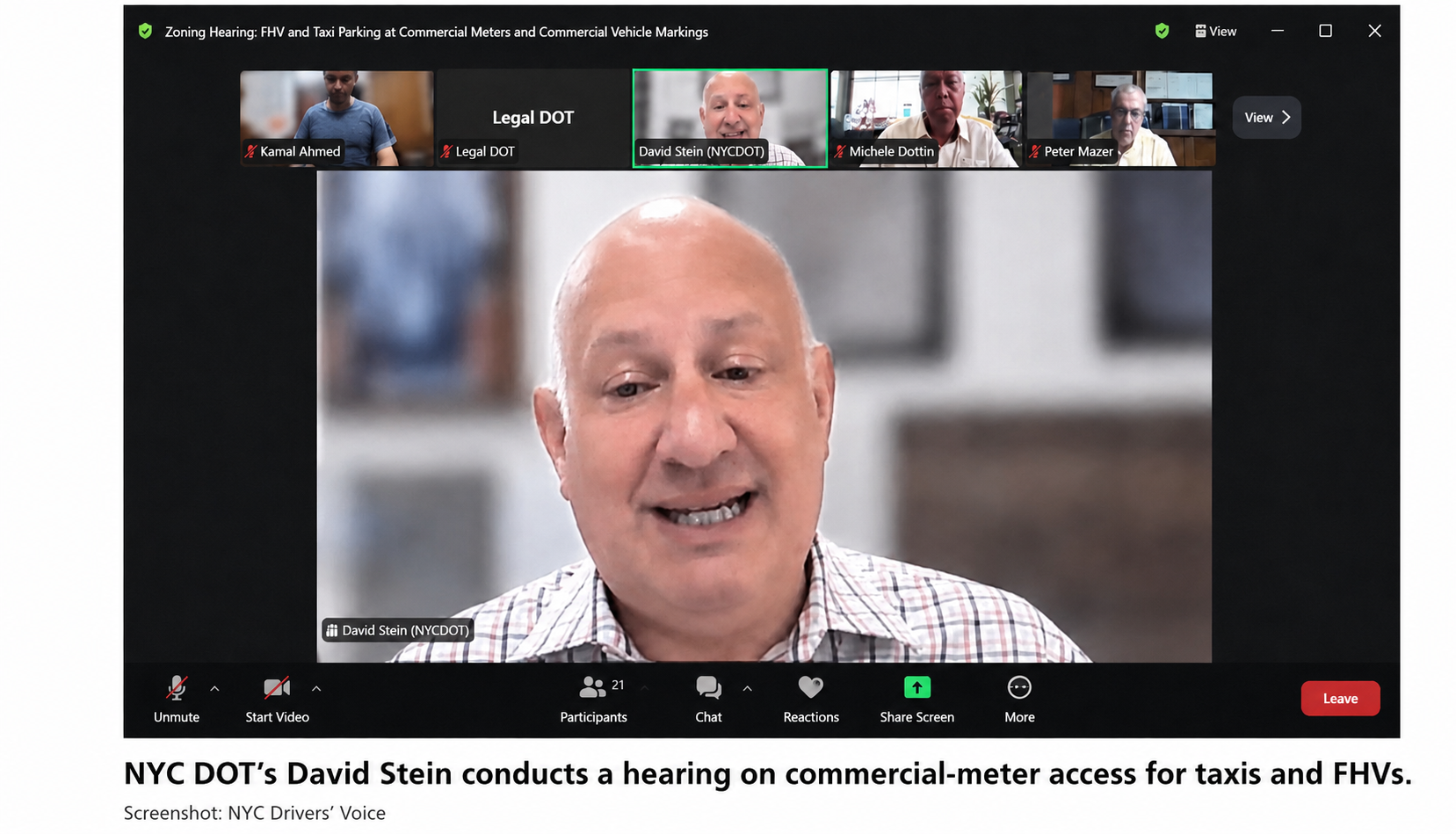
David Stein, executive director of Parking Planning and Policy at NYC DOT, conducted the hearing held at the department’s office. Approximately 15 people attended, including designated speakers and members of the public.
According to DOT, New York City has approximately 15,000 parking meters across Manhattan, Queens, Brooklyn, the Bronx and Staten Island.
Among those who testified were Metropolitan Taxicab Board of Trade General Counsel Peter Mazer; New York Taxi Workers Alliance (NYTWA) Executive Director Bhairavi Desai; Independent Drivers Guild representative Michele Dotti; driver Kuber Sancho Persad; NYC Drivers’ Voice Chief Editor Kamal Ahmed; attorney Robert Roth; and several working drivers.
Desai welcomed the proposed rule and thanked DOT for expanding access to commercial metered spaces for taxi and FHV drivers. She described the shortage of legal parking and restroom access as a public-health, labor and human-dignity issue.
“We have seen throughout the years so many drivers suffer not only from diabetes but also kidney failure,” Desai said, describing such conditions as occupational illnesses linked to drivers’ working environments.
She said drivers are frequently overworked without the scheduled breaks commonly provided to workers in other transportation sectors. Desai also urged DOT to specify that the parking spaces are intended for TLC-licensed vehicles operated by human drivers, preventing autonomous-vehicle companies from eventually using them as maintenance or staging areas.
She further asked the city to examine what she described as excessive ticketing and to consider permitting taxis and FHVs to make passenger pickups and drop-offs in bus lanes under appropriate circumstances.
Dotti said the proposal recognizes drivers’ long-running struggle for dignity and basic workplace protections. “This fight is about being able to use restrooms, stop, get out of the vehicle and walk for at least 15 minutes to stretch,” she said. “Show drivers that they matter as much as any other workers, that you hear them and that you will respond accordingly.”
FHV driver Yieldi Hernandez described the particular difficulties women drivers face when trying to find accessible restrooms. “As a female driver, I have difficulties using the bathroom,” Hernandez said. “They barely let us use bathrooms anywhere in the city. This has caused serious health issues for drivers.”
She urged the city to increase restroom availability near designated parking areas, particularly for women drivers.
Mazer called Local Law 24 “a practical solution” to a longstanding problem facing the industry.
Roth also supported the proposal, arguing that taxis, FHVs and commercial vehicles are all engaged in business activities and should therefore receive equal access to commercial metered spaces.
Kamal Ahmed, chief editor of NYC Drivers’ Voice, urged the city to view the proposal not only as a parking measure but also as an opportunity to address drivers’ health, safety and limited access to restrooms.
Ahmed called on DOT to adopt the rule and partner with nearby businesses and public facilities to establish a driver restroom-access program. He emphasized that drivers need both a legal place to park and a humane place to attend to their basic needs.
He also argued that allowing drivers to take necessary breaks could reduce fatigue, improve road safety and help them maintain professional service standards.
The testimony reflected broad support for expanding commercial-meter access, while underscoring that additional parking alone will not fully address the difficult working conditions drivers experience. Advocates urged the city to pair the rule with practical measures that provide safe, reliable and dignified access to restrooms and rest breaks.
The city’s Taxi & Limousine Commission (TLC) licenses between 180,000 and 200,000 drivers, who provide one million rides per day… or 600 to 612 trips per minute, according to the latest statistics available.
Kamal Ahmed holds a master’s degree in economics and an associate degree in health sciences. He has more than a decade of experience in the for-hire vehicle (FHV) industry and worked with the American Transit Insurance Company (ATIC), currently serving as a consultant to both sectors. Previously, he worked for daily newspapers and the national news agency of Bangladesh. He also served as a stringer to Reuters, Agence France-Presse (AFP), Press Trust of India (PTI), and the Xinhua News Agency.

3 Responses
Excellent article
Thank you for your valuable comment
Good news for cabbies. Yellow cabs long cherished demand is going to be materialized.