
NEW YORK, Aug 11, (NYCDV) – Losing access to Uber or Lyft can have immediate financial consequences for New York City For-Hire Vehicles (FHV) drivers. A deactivation can suddenly cut off the income that pays for rent, car payments, and family’s everyday expenses.
A survey of 350 app-based drivers, highlighted by the Asian American Legal Defense and Education Fund (AALDEF), shows the potentially severe consequences of driver deactivation.
On Jan 29, 2026, New York City enacted Local Law 52, establishing new protections for app- based drivers facing deactivation. On June 10, Uber and Lyft sued the city, arguing the law could require them to retain drivers who pose public safety risks. On July 22, a Federal Judge in Manhattan issued a preliminary injunction blocking the law from taking effect.
However, the legal battle continues, with the City Law Department filing a notice of appeal last week challenging the federal court’s ruling.
“The City Law Department filed a notice of appeal. I don’t know the court schedule by when they will file the appeal itself,” New York Taxi Workers Alliance (NYTWA) Executive Director Bhairavi Desai told the NYC Drivers Voice.
According to the report titled ‘Deactivated Without Cause’, released in October 2025, more than 70% of surveyed deactivated drivers received no warning, while over 90% remained locked out despite attempting to appeals.
The report found that 95% of surveyed drivers said driving was their family’s primary source of income, while 85% had purchased vehicles specifically to work for the apps.
One driver cited in the report said losing access to the platform resulted in roughly $30,000 in vehicle-related losses and contributed to his daughter leaving college. Another reported struggling to afford medicine for a sick parent.
The survey also found that 95% of respondents were people of color and 69% were Asian, highlighting the impact deactivation policies can have on immigrant and minority communities.
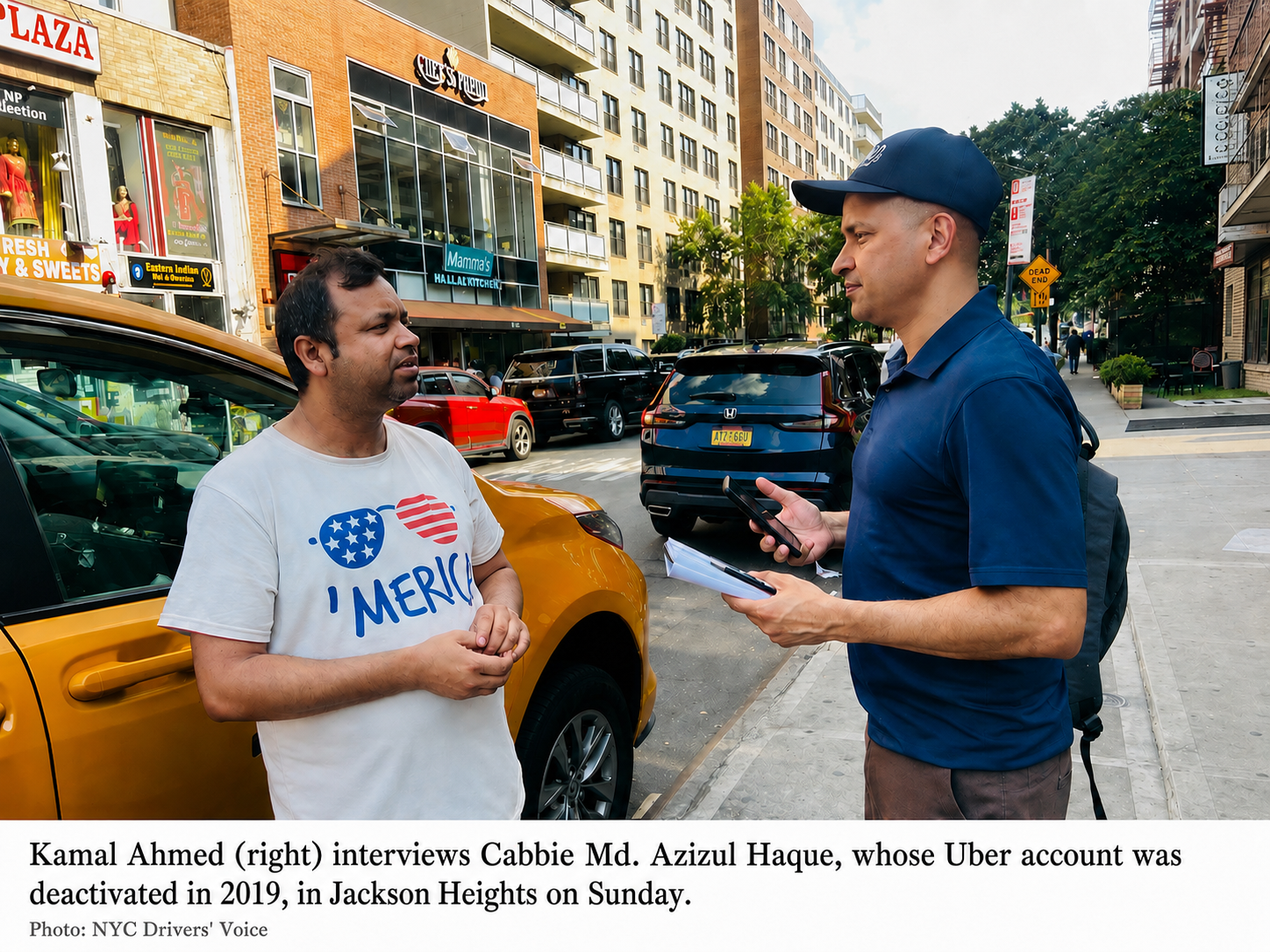
This correspondent also interviewed drivers whose accounts had been deactivated.
Nadirul Topu, who now drives for Lyft, said Uber deactivated his account in 2015, citing poor passenger ratings.
“The deactivation affected me psychologically and caused serious financial hardship,” Topu said. “I sought help from several organizations, including the Independent Drivers Guild (IDG), but I was unable to resolve the issue. I had purchased a Toyota RAV4 for $37,000 and needed to earn about $1,800 to $2,000 a month to cover my car payments, insurance, rent and family expenses.”
Md. Azizul Haque, a veteran New York City yellow cab driver, said his American dream was shattered after Uber deactivated his account in 2019.
“I needed to earn about $3,000 a month just to cover my basic expenses, but after Uber fired me, I lost everything,” Haque said. “For six or seven months, I couldn’t pay my rent or make payments on the car I had purchased for $60,000.”
Haque said the financial consequences continued long after the deactivation.
“I was broke for seven months. I survived by using credit cards and borrowing money from friends. I still owe about $70,000,” he said, adding, “Now I drive a yellow cab just to survive from hand to mouth.”
As New York continues debating the rights and responsibilities of app-based companies and the drivers who power their platforms, the AALDEF findings put a human face on that debate.
For drivers, the question is no longer simply whether platforms have the right to deactivate accounts. It is whether workers whose livelihoods can disappear with the push of a button should also have the right to know why- and a fair opportunity to challenge the decision.
Kamal Ahmed holds a Master’s Degree in Economics. He has more than a decade of experience in New York City’s for-hire vehicle industry and has worked with the American Transit Insurance Company (ATIC). He currently serves as an industry consultant. He is the Chief Editor of NYC Drivers’ Voice. Previously, he worked for leading daily newspapers in Bangladesh and the country’s national news agency and also contributed as a stringer to international news agencies, including Reuters, AFP, Xinhua, and PTI.


2 Responses
very good article.. I hope everyone understands the situations of corporate controlled industry .. we need driver protection law local law 52 to protect drivers .. we can let corporate control everything.. we lost couple of drivers life’s .. consequences is very serious
Thank you for your valuable comment